


Rotate placement to protect teeth: nicotine pouches can cause local gum recession
Short verdict: nicotine pouches are not risk-free. Repeated placement at the same gum site can cause local irritation, and in documented cases, recession and mucosal changes. Case reports and laboratory studies point to site-specific harm, while a clinical trial found gum inflammation actually fell when smokers switched to pouches. If you use them, rotate the placement spot and see a dentist if any soreness or white patch does not clear up.
TL;DR:
- Repeated same-site placement of nicotine pouches can cause localized gum recession, leukoplakia, and mucosal changes, especially with long-term use over months.
- Using pouches frequently for most of the day, especially with higher nicotine strength, significantly increases the risk of gum damage and white patches.
- Rotating pouch placement, maintaining good oral hygiene, and monitoring for persistent soreness or white patches reduce the risk of tissue damage.
- Laboratory and clinical evidence suggest chemical and mechanical damage from nicotine and pressure, but long-term effects like periodontal disease or cancer remain unstudied.
- Dentists often identify pouch-related tissue changes through targeted exams and advise early intervention if lesions or soreness persist.
Table of Contents
- What nicotine pouches actually do to your teeth and gums
- What the research actually shows so far
- How pouches might be causing this damage
- Who is most at risk, and the early warning signs
- How dentists detect and manage pouch-related problems
- Practical steps to lower your oral risk
- FUZE’s approach to product design and evidence
- Using pouches alongside periodontal disease or braces
- Publisher perspective: balancing harm reduction with oral safety
- Where to buy FUZE responsibly
- Sources
- FAQ
What nicotine pouches actually do to your teeth and gums
Dentists are seeing a specific, recognisable pattern in patients who use nicotine pouches heavily: localised damage exactly where the pouch sits, not generalised tooth decay. Two clinical case reports describe gingival recession and leukoplakia appearing precisely at habitual placement sites after 11 to 18 months of regular use. Leukoplakia is a white patch on the mucosa that dentists treat as a warning sign requiring investigation, not a cosmetic quirk.
The tissue effects tend to cluster into a few recognisable categories:
- Gum recession and root exposure at the pouch’s usual resting spot
- White, thickened mucosal patches (keratosis) from sustained contact
- Soreness, minor blistering and a dry mouth during and after use
- Altered sensation or numbness in the gum area, reported anecdotally by regular users
- Increased tooth sensitivity where the gum line has receded
Cavities are a separate question from gum damage. Most pouches use non-sugar sweeteners, so the direct cariogenic risk looks fairly low. But the pouch sits against the gum for 30 to 60 minutes at a time, and plaque can build up in that sheltered spot more readily, raising local decay risk near the gum margin even when the sweetener itself is not the problem.
Statistic Callout: In the randomised trial comparing continued smokers with those who switched to on!® pouches, gingival inflammation scores fell by roughly 20 to 28% over 12 to 24 weeks, alongside a similar drop in bleeding on probing. That is a whole-mouth improvement tied to quitting cigarettes, not proof that pouches are harmless at the spot where they sit.
What the research actually shows so far
The evidence on nicotine pouches and oral health sits on three legs: case reports, laboratory work and one clinical trial. None of them, alone, settles the question.
- Case reports. Two published cases link months of repeated same-site placement to gingival recession and leukoplakia in otherwise healthy young adults. Case reports flag a pattern worth investigating; they do not prove how common it is.
- Systematic and narrative reviews. Broader reviews of emerging oral nicotine products describe the evidence base as limited and mixed, consistently flagging the possibility of localised lesions and calling for longer-term studies.
- Laboratory studies. In vitro work shows pouch extracts and nicotine itself can reduce gum cell viability and shift inflammatory cytokine activity, giving a plausible biological explanation for what the case reports describe.
- The clinical trial. The on!® trial found reduced gingival inflammation in smokers who switched to pouches, but that result is best read as a smoking-cessation effect on the whole mouth, not a clean bill of health for the placement site itself.
The gap that remains is long-term. Nobody has yet published multi-year cohort data tracking pouch users for periodontal outcomes or cancer risk, which is exactly the kind of study this evidence base still needs.
How pouches might be causing this damage
Two separate mechanisms are probably at work, and they can compound each other.
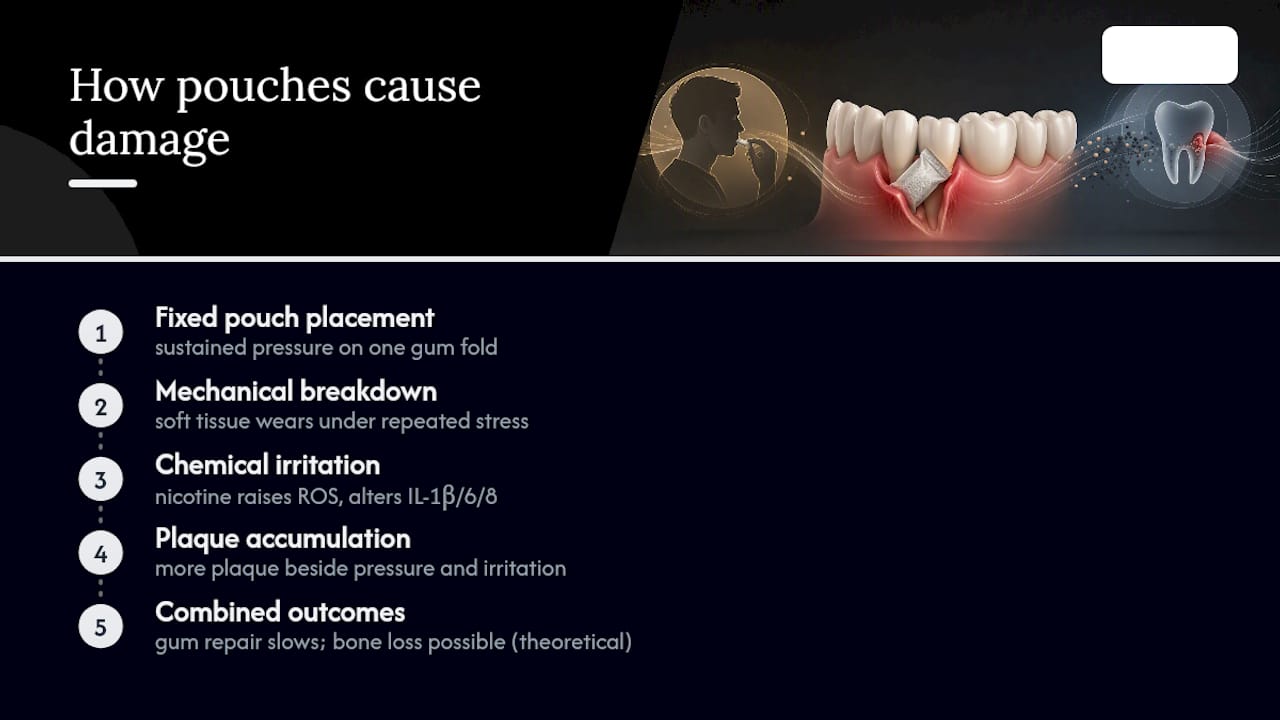
The first is purely mechanical. Holding a pouch against the same fold of gum tissue for half an hour or more, multiple times a day, creates sustained pressure. Soft tissue under repeated mechanical stress breaks down, much like a shoe that rubs the same spot on your heel until a blister forms.
The second is chemical. Nicotine appears to raise reactive oxygen species and disturb the balance of inflammatory mediators such as IL-1β, IL-6 and IL-8 in gum tissue, which can slow the gum’s normal repair process. There is also laboratory evidence that nicotine interacts with pathways involved in bone remodelling, raising a theoretical concern about accelerated bone loss around teeth with heavy, sustained use, though this has not been confirmed in long-term human studies.
Add to that a local microbiome shift: plaque tends to accumulate more readily against fixed pouch placement, adjacent to the pressure and chemical irritation.
Pro Tip: If you notice a slight wrinkling of the gum or an odd sensation in your jaw after weeks of use, treat it as an early warning rather than a cosmetic nuisance. That subtle change is often the first visible sign before more obvious tissue damage sets in.
Who is most at risk, and the early warning signs
Risk is not evenly distributed among pouch users. It concentrates around a handful of habits.
- Same-site placement. Tucking the pouch in the identical spot every single time is the single biggest driver of localised recession and leukoplakia.
- Frequency and duration. Using pouches for most of the day, back to back, extends total contact time far beyond an occasional user’s exposure.
- Higher nicotine strength. Stronger formulations mean more concentrated local exposure to nicotine at the tissue surface.
- Dual use with smoking. Combining pouches with continued cigarette use stacks two separate sources of oral irritation.
- Flavour and pH factors. Certain flavourings and alkalinising agents may increase local irritation, though this varies by product.
Watch for persistent soreness, a white patch that will not resolve, visible gum recession, new tooth sensitivity, or a dry mouth that lingers after you have removed the pouch. A simple habit worth adopting: photograph the placement site every few weeks so you and your dentist can compare changes over time rather than relying on memory.
How dentists detect and manage pouch-related problems
A dental check for pouch users looks a bit different from a routine exam, mostly because the damage is localised and easy to miss unless someone is looking for it specifically.
- Clinicians use standardised measures such as the Modified Gingival Index (MGI) and a Bleeding Index, alongside routine periodontal probing and charting, to track inflammation at specific sites over time.
- Visual inspection and photographic mapping of the mucosa help identify white patches or keratosis before they progress.
- Biopsy becomes the right next step for any white lesion that persists beyond two to three weeks or looks irregular, since leukoplakia occasionally requires histological confirmation to rule out more serious pathology.
- Management usually combines localised periodontal therapy, improved hygiene around the affected site, rotating or stopping pouch placement, and referral to a specialist when lesions do not resolve.
Tell your dentist you use nicotine pouches, explicitly and early. Clinicians increasingly ask about pouch use during routine tobacco histories precisely because patients often do not volunteer it, and the early signs can be subtle enough to miss without asking directly.
Practical steps to lower your oral risk
None of these require giving up pouches altogether, but each one reduces the localised load on your gum tissue.
- Rotate the placement spot every single use. This is the simplest, highest-impact change you can make, since consistent same-site placement is the main driver behind recession and leukoplakia.
- Trim your daily count and session length where you reasonably can, following the guidance on the product packaging.
- Tighten your hygiene routine around the site. Brush and floss thoroughly, rinse after removing a pouch, and consider a weekly antiseptic mouth rinse.
- Stop and book a dental review the moment soreness or a white patch lingers beyond a couple of weeks.
- If you have switched from smoking, expect whole-mouth inflammation to improve, but keep monitoring the specific gum area where you place your pouch.
Pro Tip: Rotating placement takes seconds and costs nothing, yet it is the single habit dentists point to most often when discussing how to reduce localised pouch-related tissue damage.
FUZE’s approach to product design and evidence
FUZE builds nicotine pouches specifically for the Irish market, using rapid-release, low-drip pouch technology across three long-lasting flavours, including Triple Mint 20mg. Same-day delivery applies to orders placed by 6pm in eligible areas.
A few things worth knowing about how the product interacts with your mouth:
- Rapid-release technology is designed to shorten the time nicotine needs to reach effective levels, which does not change the contact-time considerations covered above.
- Low-drip formulation reduces liquid seepage during use, but placement duration and site rotation remain the factors that matter most for gum health.
- Each pouch is designed to last between 30 and 60 minutes, so total daily contact time still depends on how many pouches you use and where you place them.
- FUZE’s guidance to customers: rotate placement, follow the usage instructions on pack, and contact customer support with any product questions.
If you notice persistent soreness or a lesion that will not clear, that is a signal to see a dentist, not a product fault to trouble-shoot at home.
Using pouches alongside periodontal disease or braces
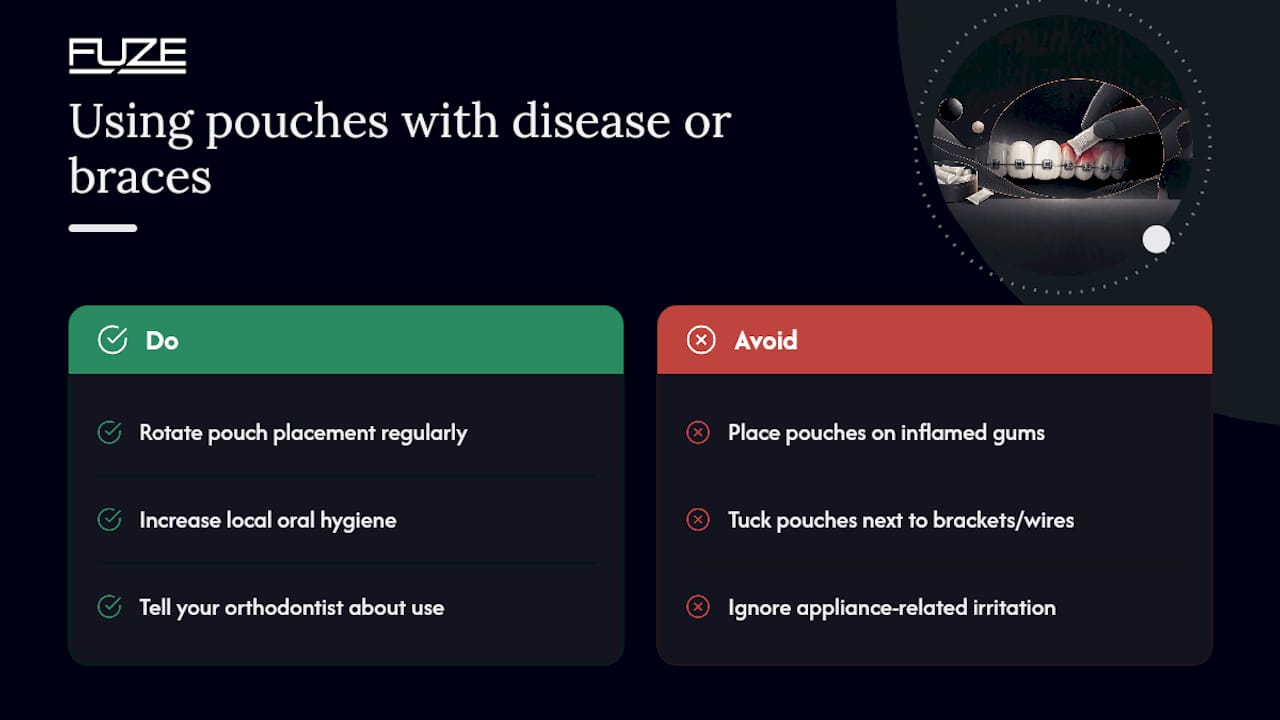
If you already have periodontal disease, adding sustained pressure and local chemical irritation from a pouch to gum tissue that is already inflamed and structurally compromised is not a neutral combination. Periodontal disease involves ongoing breakdown of the tissue and bone supporting your teeth, and the same inflammatory pathways implicated in pouch-related tissue changes overlap with those already active in periodontal disease. That does not mean pouches cause periodontal disease, but using them at a site already weakened by gum disease plausibly adds insult to an area with less capacity to repair itself.
Orthodontic appliances raise a different, more mechanical concern. Braces, wires and brackets already create tight spaces where plaque collects easily. Tucking a pouch against the gum near a bracket or wire adds another surface for plaque to build against, and the added pressure from the appliance itself can compound the mechanical irritation a pouch already creates. Anyone wearing fixed orthodontic appliances should be especially careful about hygiene around the pouch site and should mention pouch use to their orthodontist, not just their general dentist, since appliance adjustments and oral irritation can interact in ways a routine check might miss.
If you are managing either condition, rotating placement and stepping up local hygiene matters more, not less.
Publisher perspective: balancing harm reduction with oral safety
Nicotine pouches are not risk-free, and the research is still catching up. If you are an adult who chooses to use them, do it with basic discipline: rotate placement, keep an eye on the site, and see a dentist the moment something looks or feels wrong. FUZE will keep updating this guidance as better evidence arrives.
— FUZE Team
Where to buy FUZE responsibly
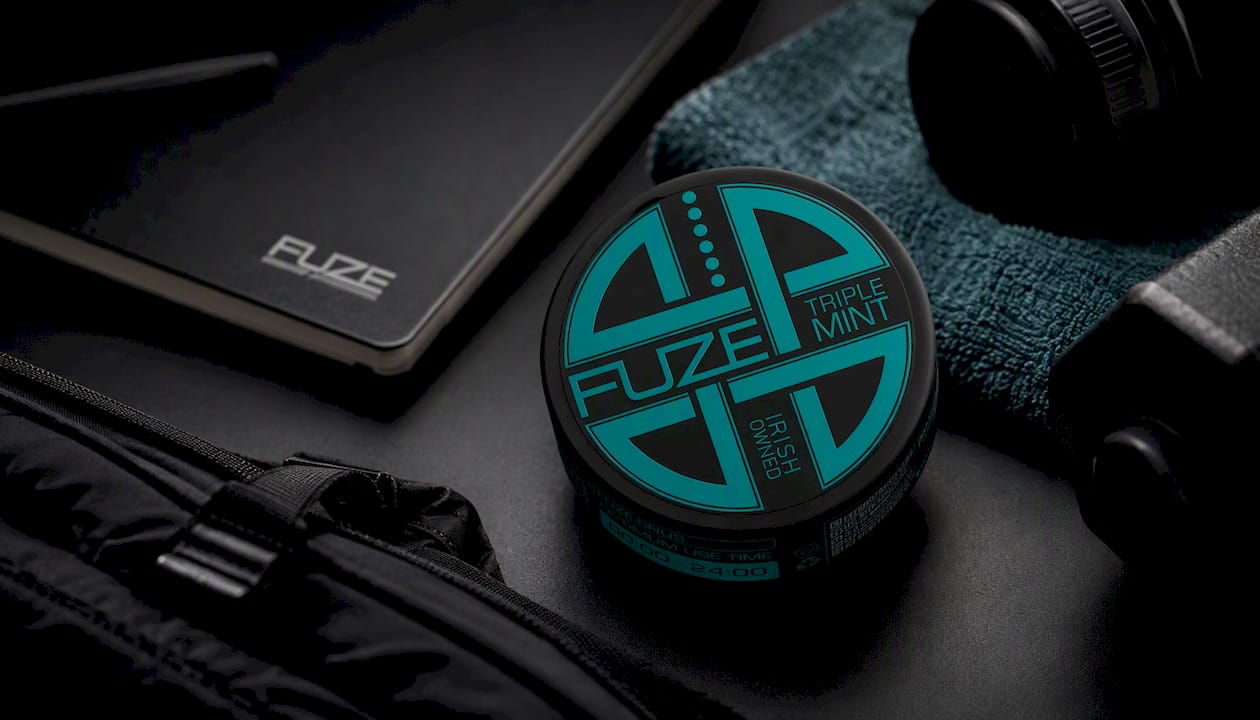
FUZE’s Triple Mint 20mg pouch delivers rapid-release nicotine with low drip, built for adults who want a smooth, mint-forward flavour that lasts 30 to 60 minutes per pouch. It is available now on the Triple Mint 20mg product page, with same-day delivery for orders placed by 6pm in eligible areas.
 Choosing a pouch does not remove the need for basic dental care around it. Rotate your placement site with every use, keep your hygiene routine tight around the gum line, and book a dental check if any soreness or white patch does not settle within a couple of weeks. For a wider look at how pouches compare with other nicotine products, FUZE’s guide on snus and vapes covers the practical differences. When you are ready, head to the Triple Mint 20mg page to check current stock and delivery options for your area.
Sources
- Localized gingival recession and leukoplakia associated with nicotine pouch use: two clinical case reports - PMC
- Emerging oral nicotine products and periodontal diseases - PMC
This article is general information, not a substitute for advice from a qualified doctor. Consult a qualified healthcare professional about your own circumstances before acting on anything here.
FAQ
Can nicotine pouches be bad for your teeth and gums?
Yes. Case reports link repeated same-site use to gum recession and leukoplakia, though the direct cavity risk from the pouch itself appears low since most use non-sugar sweeteners.
Can dentists tell if you use nicotine pouches?
Often, yes. Dentists look for localised gum recession, white mucosal patches, or soreness at a specific spot, and increasingly ask directly about pouch use during routine tobacco histories.
Is using one pouch a day bad for your gums?
Occasional, rotated use carries far less local risk than frequent same-site placement. The evidence pointing to recession and leukoplakia comes from regular, repeated use over many months at one fixed location, not isolated occasional use.
What are the downsides of nicotine pouches?
The main documented downsides are localised gum irritation, soreness, dry mouth, and, with sustained same-site use, recession or white patches. Long-term data on cancer risk and periodontal outcomes still does not exist.
Do nicotine pouches stain your teeth?
Unlike smoking or traditional smokeless tobacco, pouches are not commonly reported to cause the same visible tooth staining, since they contain no combustion products or tobacco leaf, though individual reactions and dental hygiene habits vary.
Recommended
- Tobacco-free Snus (Nicotine Pouches) vs Vapes
- Vapes vs Snus ( Nicotine Pouches ) in Ireland
- What is a Snus | Nicotine pouch and how do I use it?
This is for general information purposes only, not medical advice. Please consult your doctor if you have medical queries. This article may not be fully accurate or fully researched. Please do your own research and consult professionals before using nicotine. Nicotine is an addictive substance.